What Is Process Consulting?
What Is Process Consulting? Why Content Consulting Is Losing Value in the AI Era
5 min read ·
Aug 7, 2026
For decades, consulting operated on a simple premise: clients hired experts because experts had answers. The consultant's value came from knowledge—frameworks, best practices, recommendations, industry expertise, and proven solutions. The more answers a consultant possessed, the more valuable that consultant became. Entire consulting firms, professional services businesses, and individual careers were built around this assumption.
What Is Content Consulting?
What Is Process Consulting?
Why Content Consulting Is Becoming Harder to Sell
The most important trend affecting consulting today is the shrinking shelf life of expertise. A framework that worked two years ago may already be losing relevance. A best practice can quickly become an outdated practice. Recommendations developed under one set of market conditions often fail when volatility changes the context. As a result, expertise remains important, but its useful lifespan is becoming dramatically shorter than it was even a decade ago.
Why Process Consulting Is Growing So Fast
Content Consulting vs Process Consulting
What Consultants Should Do Now
For decades, consulting operated on a relatively simple premise: clients hired experts because experts had answers. The consultant's value came from knowledge—frameworks, best practices, recommendations, industry expertise, methodologies, and proven solutions. The more answers a consultant possessed, the more valuable that consultant became.
This assumption shaped an entire industry. It also shaped how consultants thought about themselves and their work. Expertise meant accumulating knowledge, developing intellectual property, refining frameworks, and becoming the person in the room who could diagnose a problem and prescribe a solution. Consulting firms grew by capturing knowledge, systematizing it, and deploying it across clients. Independent consultants built reputations around specialized expertise and accumulated experience.
For a long time, this model worked remarkably well. Clients often faced challenges that had been encountered before, and experienced advisors could provide answers that were difficult to find elsewhere. Knowledge was relatively scarce, access to information was limited, and best practices remained relevant for long periods of time.
Today, however, the conditions that supported this model are changing.
The Shelf Life of Decisions Is Shrinking
One of the most important shifts happening in consulting today is not artificial intelligence itself. It is the shrinking shelf life of knowledge.
Throughout much of the twentieth century, organizations operated in comparatively stable environments. Business models lasted for decades, industries evolved gradually, and management practices remained relevant for years. In the early industrial era, the average lifespan of a company could reach roughly 75 years. By the late twentieth century, that number had fallen closer to 15 years.
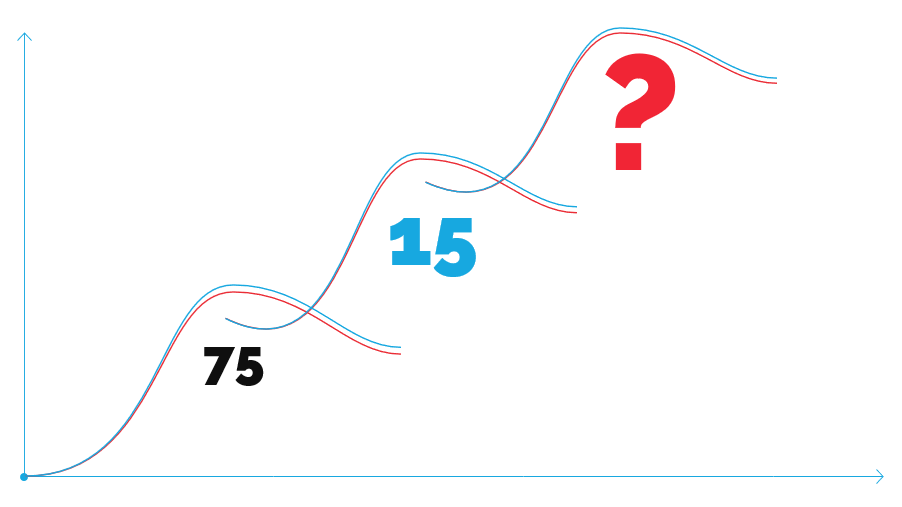
Under those conditions, a recommendation developed today could continue generating value for a long time. Consultants could confidently rely on accumulated experience because the future looked sufficiently similar to the past.
That world has largely disappeared.
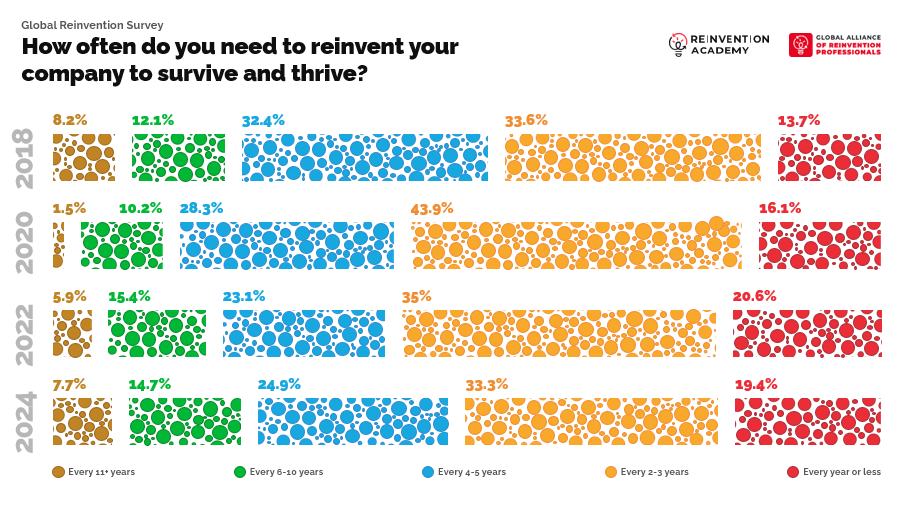
Companies are reinventing products, business models, operating systems, and capabilities far more frequently than they did even a decade ago. According to the Global Reinvention Survey, nearly half of organizations now report needing significant reinvention every two to three years, while almost one in five say they must reinvent every year or even more often.
This has profound implications for consultants.
When business cycles lasted decades, expertise accumulated value over time. A recommendation developed today could remain relevant for years. Best practices had a long shelf life.
In a post-stability economy, that assumption no longer holds.
A framework that worked three years ago may already be outdated. A successful strategy can lose effectiveness before implementation is complete. The useful life of expertise has become dramatically shorter.
What matters is no longer simply possessing the right answer—it is helping organizations continuously generate new answers as conditions change.
What Is Content Consulting?
Most consulting still operates according to what could be described as a content model.
In content consulting, the consultant diagnoses a problem, develops recommendations, and delivers answers. The client arrives with a challenge. The consultant provides expertise. The value exchange is built around knowledge transfer.
This model assumes something important: somebody already knows the answer.
The consultant's role is to discover that answer, package it effectively, and bring it into the room. Historically, this approach made sense. Organizations often faced familiar problems, and consultants could rely on accumulated expertise, established frameworks, and proven methodologies to guide decision-making.
Many forms of strategy consulting, operational consulting, training, advisory work, and executive coaching still operate this way. The consultant serves as the source of expertise, while the client becomes the recipient.
What Is Process Consulting?
Process consulting starts from a fundamentally different assumption.
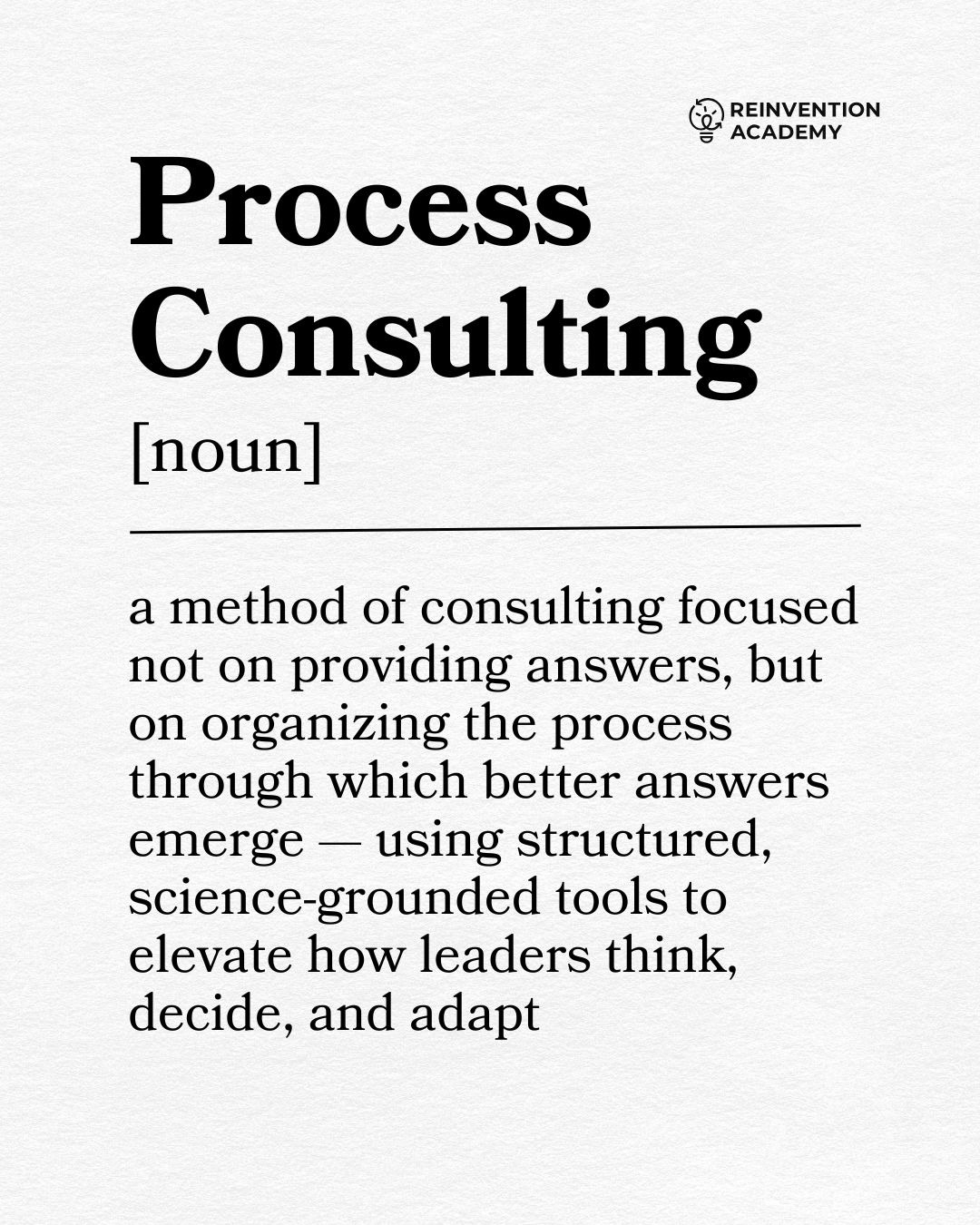
Instead of assuming that the consultant possesses the answer, process consulting assumes that the answer must be discovered. Rather than delivering solutions, the consultant designs and facilitates the process through which solutions emerge.
This changes the role of the consultant significantly.
The consultant becomes less of an expert delivering recommendations and more of a facilitator helping people think, decide, align, experiment, learn, and adapt. Instead of being the primary source of intelligence, the consultant becomes the architect of collective intelligence.
The goal is not simply to solve today's problem. The goal is to help the organization develop the capacity to navigate tomorrow's problems as well.
Importantly, process consulting does not eliminate expertise. Strong process consultants often possess deep subject-matter knowledge and extensive experience. The difference lies in how that expertise is used. Rather than positioning expertise as the final product, process consultants use expertise to design better conversations, better decision-making processes, better experiments, and better systems for adaptation.
In that sense, the product is no longer the answer.
The product is the process that helps organizations continuously generate better answers in a world where conditions keep changing.
Content Consulting vs Process Consulting
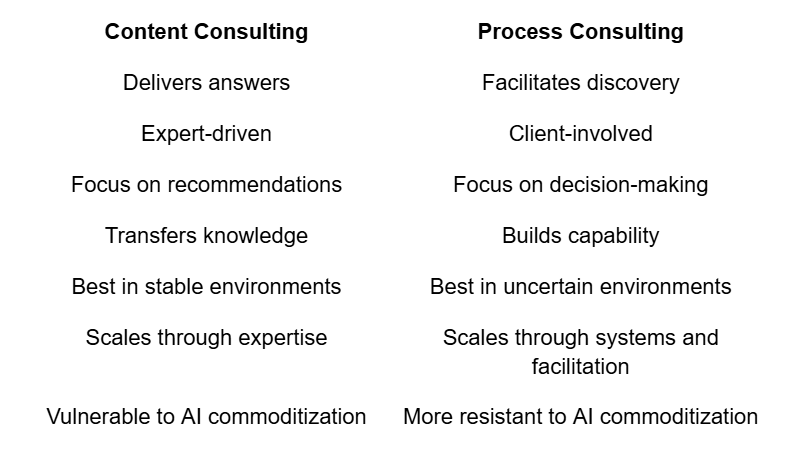
Both content consulting and process consulting create value, but they solve different problems. Content consulting is most effective when expertise is scarce and the challenge is relatively well understood. Process consulting becomes more valuable when uncertainty is high, answers have short shelf lives, and organizations need the capacity to adapt rather than simply follow recommendations. As business environments become more volatile, many consultants are finding that the market increasingly rewards process capabilities alongside traditional expertise.
Process consulting is not a new idea. What is changing today is not the existence of process consulting, but its growing importance.
What Consultants Should Do Now
Clients will continue to need specialists, industry knowledge, and informed judgment. But expertise is increasingly becoming an input rather than the final product.
The more useful question is:
"How can I help clients continuously generate better answers?"
For many consultants, that means expanding beyond recommendations and frameworks into facilitation, decision-making, alignment, experimentation, and capability-building. The goal is no longer simply to solve today's problem. It is to help organizations become better at solving tomorrow's problems as well.
In a world where expertise has a shorter shelf life, the most valuable consultants may not be those with the most answers. They may be those who help clients navigate uncertainty long after the engagement ends.
.svg)

Join 15,000+ professionals reading Reinvention Weekly