The Future of Consulting: 9 Trends Reshaping the Industry in 2026
9 Trends Reshaping the Consulting Industry in 2026
The consulting industry is entering its most important reset in decades.
For years, consultants, coaches, advisors, trainers, and fractional leaders could build successful businesses around expertise, proven frameworks, hourly fees, polished decks, and best practices borrowed from past success.
That model is now under pressure from every direction.
AI is compressing research, analysis, synthesis, and first-draft strategy work from weeks into hours. Clients are demanding faster results, clearer accountability, and more customized solutions. Business cycles are shrinking. Pricing models are shifting. And in a volatile market, leaders no longer want more advice. They want relief, clarity, and a credible path forward.
I have been in the consulting business since 2007. My own consulting practice took off during the 2008 financial crisis—one of the first moments when I saw, in real time, how quickly “normal business” can disappear and how urgently leaders need help making sense of disruption.
Since then, I have worked with organizations including Coca-Cola, IBM, Cisco, L’Oréal Group, Danone, and Henkel on reinventing products, leadership practices, and business models for changing market realities.
So, when I look at the future of consulting in 2026, I am not looking at it only as a commentator. I am looking at it as a scientist who has studied business cycles and reinvention for more than a decade, as a business owner who has had to reinvent her own work repeatedly, and as a consultant who has sat with leaders when old strategies stopped working.
The conclusion is clear: consulting is moving from a stability-era profession to a post-stability profession.
Here are the 9 trends reshaping the consulting industry in 2026—and what consultants, coaches, advisors, fractional leaders, and experts-for-hire must do to stay relevant.
Trend #1: Consulting “Best Practices” Are Becoming Dangerous
For years, a large part of the consulting and training business was built on ready-made solutions.
Many of us have seen the cliché version of this model: the big consulting deck where someone forgot to remove the previous client’s logo. The mistake is funny because everyone recognizes it. But it also exposes the logic that shaped consulting for decades: take a proven answer, adjust the context, and sell it again.
Years ago in London, McKinsey partners told me they would not take on a new project unless, by the time they walked out of the client's office and got into the taxi, they already knew which template they would use to deliver it. At the time, that sounded like operational discipline. And in many ways, it was. But in 2026, that same logic has become dangerous.
Every consulting solution now has a shorter shelf life. A recommendation that works today may be outdated in a few months, which means it can only be treated as a hypothesis—to test, adapt, and redesign as reality changes.
Clients do not need generic answers. They need help reading their specific reality and finding the next viable move. Off-the-shelf consulting is disappearing because mass customization is now the expectation.
If your offer still depends on delivering the same answer to every client, your margin will be under pressure. If your work helps clients find better answers faster, your value increases.
Trend #2: Content Consulting Is Being Replaced by Process Consulting
For decades, consulting expertise was defined by content.
You knew the model, the framework, the benchmark, the case study, the five steps, and the “proven” sequence of actions.
That was content consulting: the consultant as a library of answers.
The more answers you carried, the more valuable you seemed.
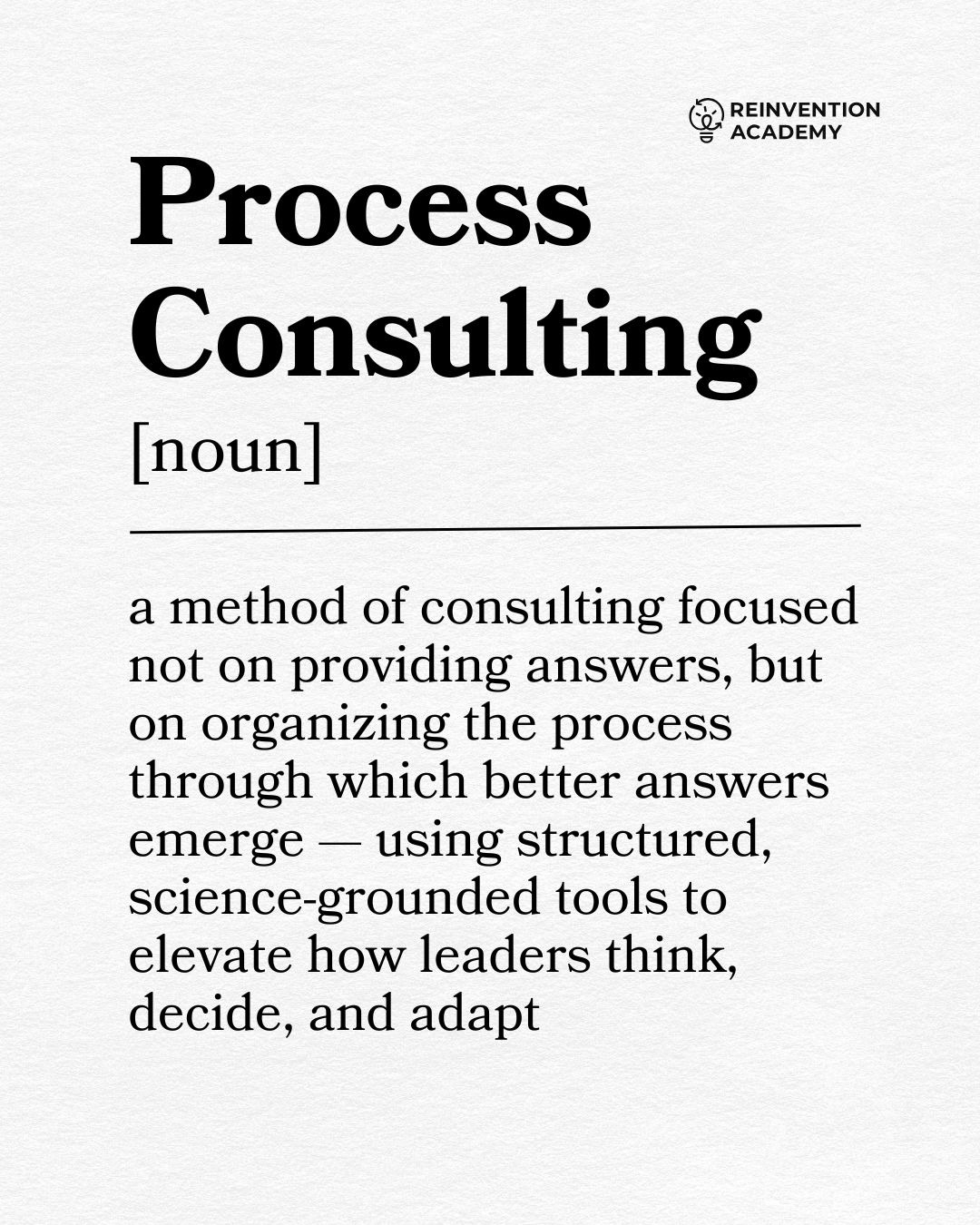
Process consulting makes a different promise.
It does not start with: “I know the answer.”
It starts with: “I know how to help this organization find the right answer under uncertainty.”
The consultant’s value shifts from providing answers to organizing the process through which better answers emerge.
That means helping clients see reality more clearly, test better hypotheses, make better decisions, and adapt when the first answer expires.
And for consultants who want to keep their practice relevant, this is the moment to roll up their sleeves.
Trend #3: Consulting Specialization Is No Longer Enough
For decades, specialization was one of the safest ways to build a consulting business.
You picked a narrow field. You became known for it. You developed a methodology, a point of view, a client base, and a reputation. The clearer your niche, the easier it was for clients to understand why they should hire you.
That logic still matters.
But it is no longer enough.
In a slower business environment, a narrow expert could solve a narrow problem. The sales consultant improved sales. The HR consultant redesigned performance reviews. The strategy consultant built a strategic plan.
But client problems no longer arrive in clean functional boxes.
A pricing problem may actually be a business model problem. A talent problem may be an AI readiness problem. A sales problem may be a trust, positioning, or market relevance problem.
This is why narrow expertise is losing some of its protective power.
Clients still need specialists. But they increasingly need specialists who can see beyond their own discipline. They need consultants who can connect strategy, technology, talent, operations, customer behavior, culture, and financial pressure into one coherent picture.
The new premium is not “I know one thing deeply.”
In 2026, the new premium is “I know my field deeply—and I can connect it to the larger system your business is actually operating inside.”
Trend #4: Competition Is Turning Into Coopetition
The answer to complexity is not pretending you can know everything.
It is knowing what intelligence the client’s problem actually requires—and being mature enough to bring it into the room.
That is why competition in consulting is shifting toward coopetition: structured collaboration between professionals who may technically compete, but can create more value together than separately.
The old model rewarded consultants who tried to own the whole client relationship.
The new model rewards consultants who can build the right ecosystem around the client’s real problem.
Trend #5: Hourly Consulting Fees Are Giving Way to Outcome-Based Pricing
AI is making hourly fees harder to defend.
When research, analysis, synthesis, financial modeling, and first-draft strategy work can be compressed from weeks into hours, the old pricing logic starts to break. Why should a client pay more because a consultant took longer? And why should a consultant earn less because they used better tools and reached the answer faster?
At the same time, clients have less patience for beautiful decks with weak accountability.
They are under pressure from boards, investors, competitors, regulators, and employees. They do not need more advice that comes with a legal disclaimer: “This is guidance only. We guarantee nothing.” They need consulting partners who are willing to stand closer to the result.
That is why pricing is moving from time spent to value created.
Our preliminary 2026 Global Consulting Fees Survey confirms the shift:
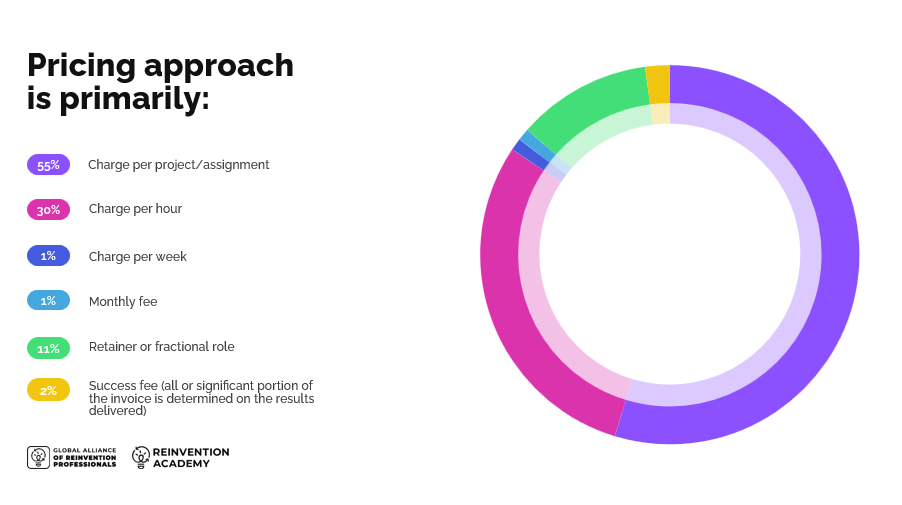
Source: 2026 Global Consulting Fees Survey by Reinvention Academy.
Only 30% of respondents still charge primarily by the hour. The largest group—55%—charges by project or assignment. Another 11% work through retainers or fractional roles, while a smaller but important group is experimenting with success fees.
That tells where the market is going.
This does not mean every consultant should move to a pure success-fee model. But it does mean that hourly billing can no longer be the center of the consulting business model.
We stopped hiding behind disclaimers and moved to success fees twelve years ago. It was not the safest move. But it was the right one. Now McKinsey is moving in the same direction, pushed by the same force many consultants are feeling.
The important question is whether you make this shift by choice—or wait until the market forces you.
Trend #6: Consultants Trained for Volatility Can Charge Premium Fees
There is another pricing shift happening underneath the move from hours to outcomes.
I call it the volatility premium.

It is the additional fee consultants, coaches, trainers, and advisors can command when their toolkit is built for the world clients are actually living in—not the stable, predictable world most consulting methodologies were designed for.
In a volatile market, clients pay for consultants who can help them make sense of chaos, redesign faster, move through uncertainty, and build adaptive capacity before the next disruption arrives.
That creates two kinds of experts-for-hire.
Those who earn more because volatility is their natural operating environment.
And those who get squeezed because they are still selling stability-era tools in a volatility-era market.
Trend #7: The Number One Hiring Criterion Has Changed
For years, the main hiring criterion in consulting was ROI. Then clients started asking for implementation. In 2026, the first thing decision-makers are buying is relief.
Most leaders are already overloaded. They are carrying AI pressure, layoffs, margin compression, internal resistance, board expectations, and personal career risk. So when a consultant arrives with another big answer, another framework, or another demanding transformation agenda, it can feel like one more burden to manage.
That means consultants are no longer competing only with other consultants. They are competing with anything that feels easier: delay, avoidance, internal workarounds, another AI tool, or simply doing nothing. The consultants who win are the ones who create relief quickly—after five minutes, after one hour, and throughout the work.
If your presence creates more pressure, clients will hesitate.
If your presence creates relief—and a credible path forward—they will keep inviting you back.
Trend #8: Independent Consultants Can Compete With Big Consulting Firms Again
AI now allows small, flexible, innovative consulting firms—and even solo consultants—to do work that previously required a much larger team.
Financial modeling, research, market analysis, synthesis, scenario development, and first-draft strategy work can now be done faster, cheaper, and often better with the right tools and the right process.
For independent consultants, this is not a threat.
It is an opportunity.
Because the market is starting to reward speed, relevance, flexibility, and results.
And that is very good news for independent consultants.
Trend #9: Shorter Business Cycles Are Forcing Consultants to Reinvent Faster
All of these trends point to one deeper shift: consulting is moving from a stability-era profession to a post-stability profession.
For most of the 20th century, business moved in long cycles. In many industries, the average business model lasted close to 75 years. That cycle compressed to roughly 15 years.
Today, the cycle is shorter again.
Since 2018, our team at Reinvention Academy has surveyed thousands of managers worldwide on how often their organizations need to reinvent to survive and thrive. In 2018, 47% said they needed to reinvent every three years or less. By 2020, that number jumped to 60%. Early 2026 data confirms the compression has not reversed.
This is not a spike.
It is the new operating tempo of business.
And consulting is not exempt.
If your clients need to rethink their business models, pricing, talent, technology, customer experience, and operating systems every few years—or faster—your consulting practice cannot rely on the same tools, pricing model, and delivery format for years.
Think of it like brushing your teeth or taking a shower.
A workshop that once felt sharp can start to feel stale. A framework that once created clarity can start to feel generic. A methodology that once helped clients move faster can quietly become part of the old world.
And yes, if you leave it untouched long enough, it starts to smell.
If your consulting model is static, you will eventually become a case study in the very problem you help clients solve.
If your consulting model is built to reinvent, your credibility increases—because clients can see that you practice the capability you sell.
A Quick Checklist for Consultants in 2026
Ask yourself:
- Am I still selling fixed answers—or helping clients build the ability to find better answers repeatedly?
- Are my frameworks treated as final recommendations—or as hypotheses to test and adapt?
- Does my specialization help clients see the larger system—or keep me trapped in one functional box?
- Is my pricing still built mostly around hours—or around outcomes, value, and ongoing partnership?
- Am I using AI to increase my strategic leverage—or waiting for AI to compress my fees?
- Do clients experience my presence as more pressure—or as relief, clarity, and a credible path forward?
- Is my toolkit built for a stable world—or for the volatile world clients are actually living in?
If most of your answers point toward the old model, this is the moment to reinvent.
.svg)

Join 15,000+ professionals reading Reinvention Weekly